Differentiable Modeling for Permafrost
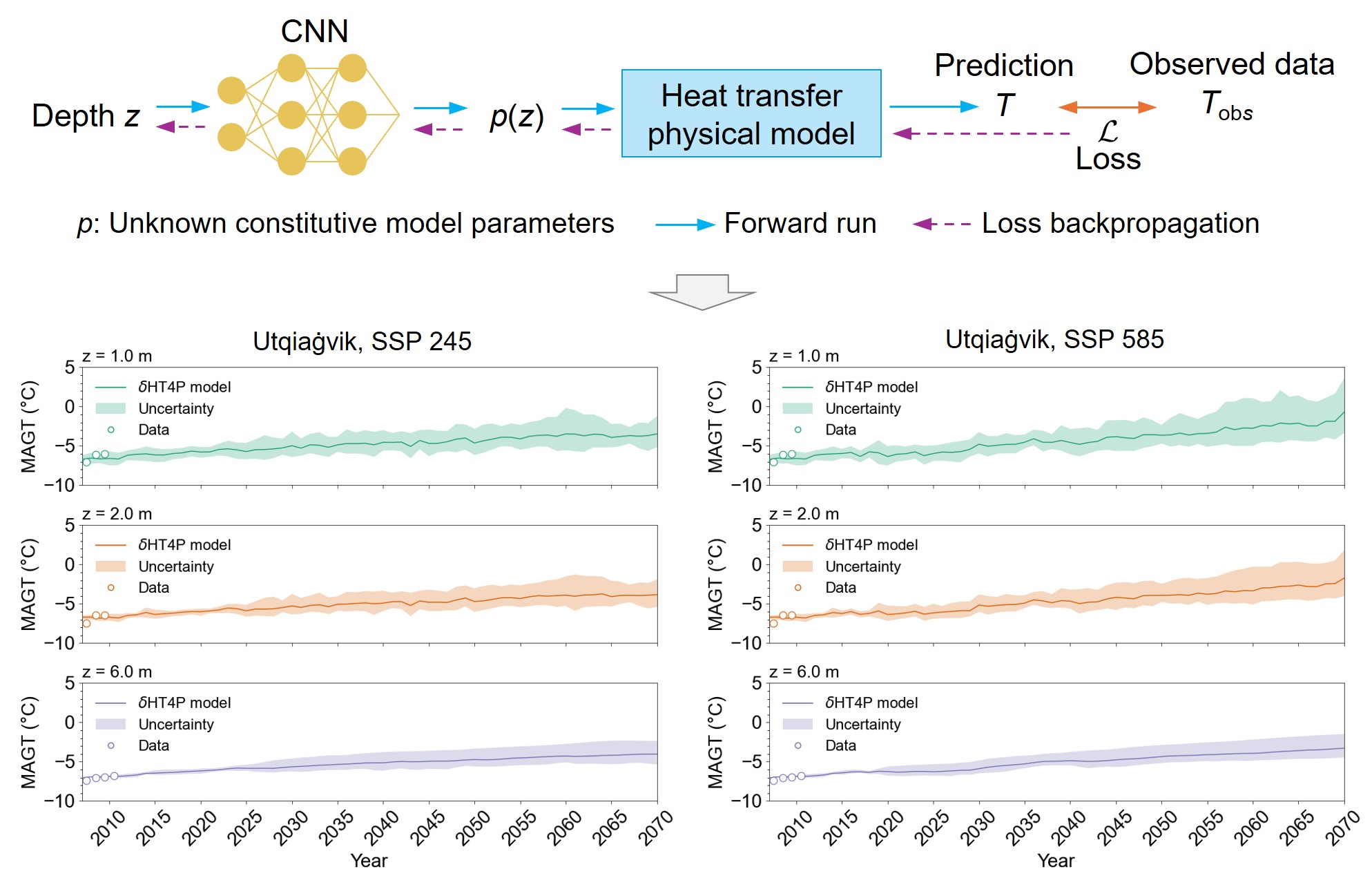
Differentiable modeling (DM) provides a powerful paradigm for scientific computing by embedding unknown constitutive relationships or model parameters directly into physical models. Through automatic differentiation (AD) or implicit function theory (IFT), model-observation misfit can be backpropagated through numerical solvers, enabling unknown physical relationships to be learned directly from observational data.
Using this approach, we developed the DMFS model, the δ-HT4P model, and a digital-twin framework for permafrost prediction. Together, these studies demonstrate the potential of DM to integrate mechanistic process models, field observations, and scientific machine learning for cold-region geotechnical and geoscience applications.
Water Potential Theory for Frozen Soils
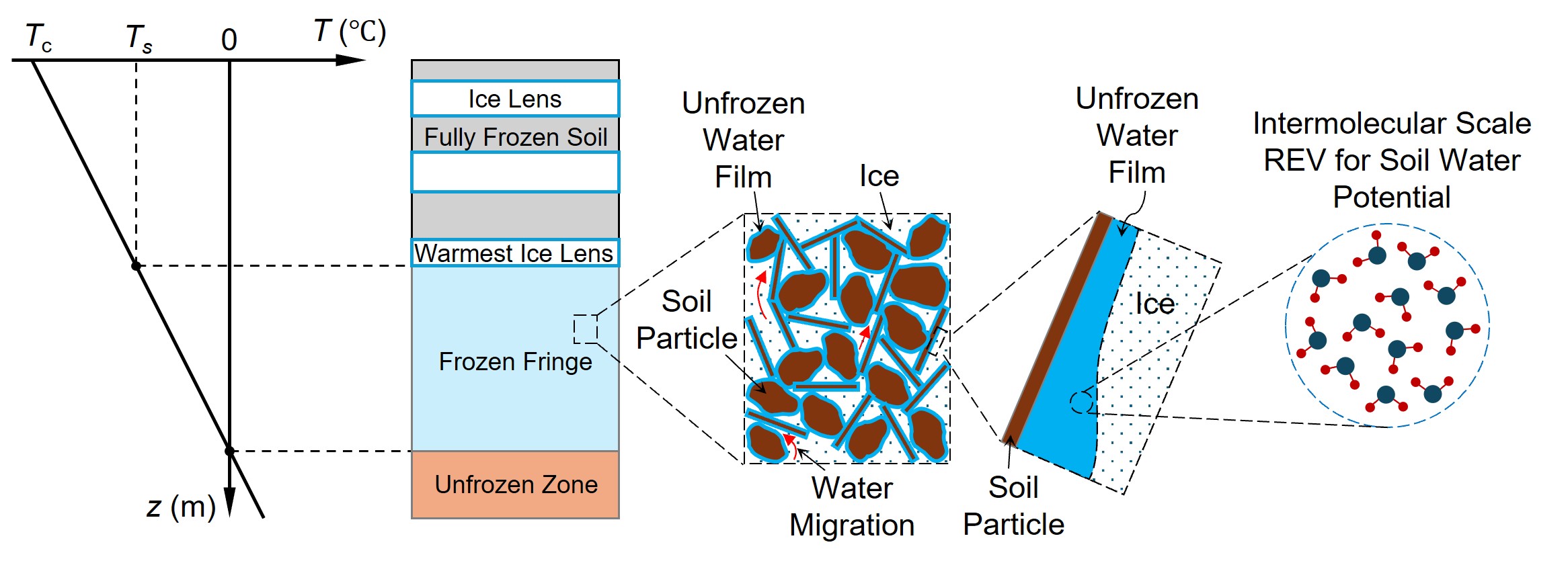
Water potential is a fundamental thermodynamic variable that describes changes in the free energy of pore water in frozen soils. Soil–water interactions reduce the free energy of pore water and consequently depress its freezing temperature, giving rise to the soil freezing characteristic curve (SFCC). Building on a molecular-scale thermodynamic system for pore water, we developed a water-potential theory for frozen soils.
Based on this theory, we clarified the physical origin of cryosuction in frozen soils and investigated the migration behavior of unfrozen water. By combining the cryosuction with the temperature-dependent hydraulic conductivity, we developed a simplified physical model for predicting frost heave. These studies provide a thermodynamic foundation for linking pore-scale soil–water interactions with macroscopic freezing, water migration, and deformation processes in frozen soils.